Africa's $180bn Agrifood Financing Gap not just a shortage of capital, its a Capital Architecture Problem.
AGRA's new 2026 report deserves to be read not only by governments, development practitioners and agriculturalists, but by DFIs, commercial banks, pension funds, sovereign wealth funds, private equity investors, family offices, infrastructure investors, climate funds and venture capital managers.
After two decades of effort, its conclusion is unusually candid.
- African agriculture has moved forward. Agricultural output has roughly doubled, albeit from a low base.
- Seed industries have grown and better, locally adapted, choices of seed from local, regional and global seed breeders, are now increasingly available to farmers to make better choices for their own conditions and risk profile.
- Agro-dealer networks are far better developed. Digital agriculture, last mile logistics such as uBeba, have appeared and IoT - Sensor tech have started to be used.
- Agribusinesses have expanded.
- Intra-African agricultural trade has grown, supported by companies such as our own Rift Valley Traders and Associates, Inc.
- Private capital now participates in a sector that, twenty years ago, was routinely written off as almost unbankable.
AGRA describes three interconnected problems: a productivity trap, a value trap and a capability trap.
1. Productivity remains too low and volatile. 2. Production does not reliably translate into farmer income, enterprise profitability and jobs. 3. And weak institutions, policies and delivery systems prevent successful models from being sustained or scaled.
For investors, I think those three traps need to be translated into something rather more specific:
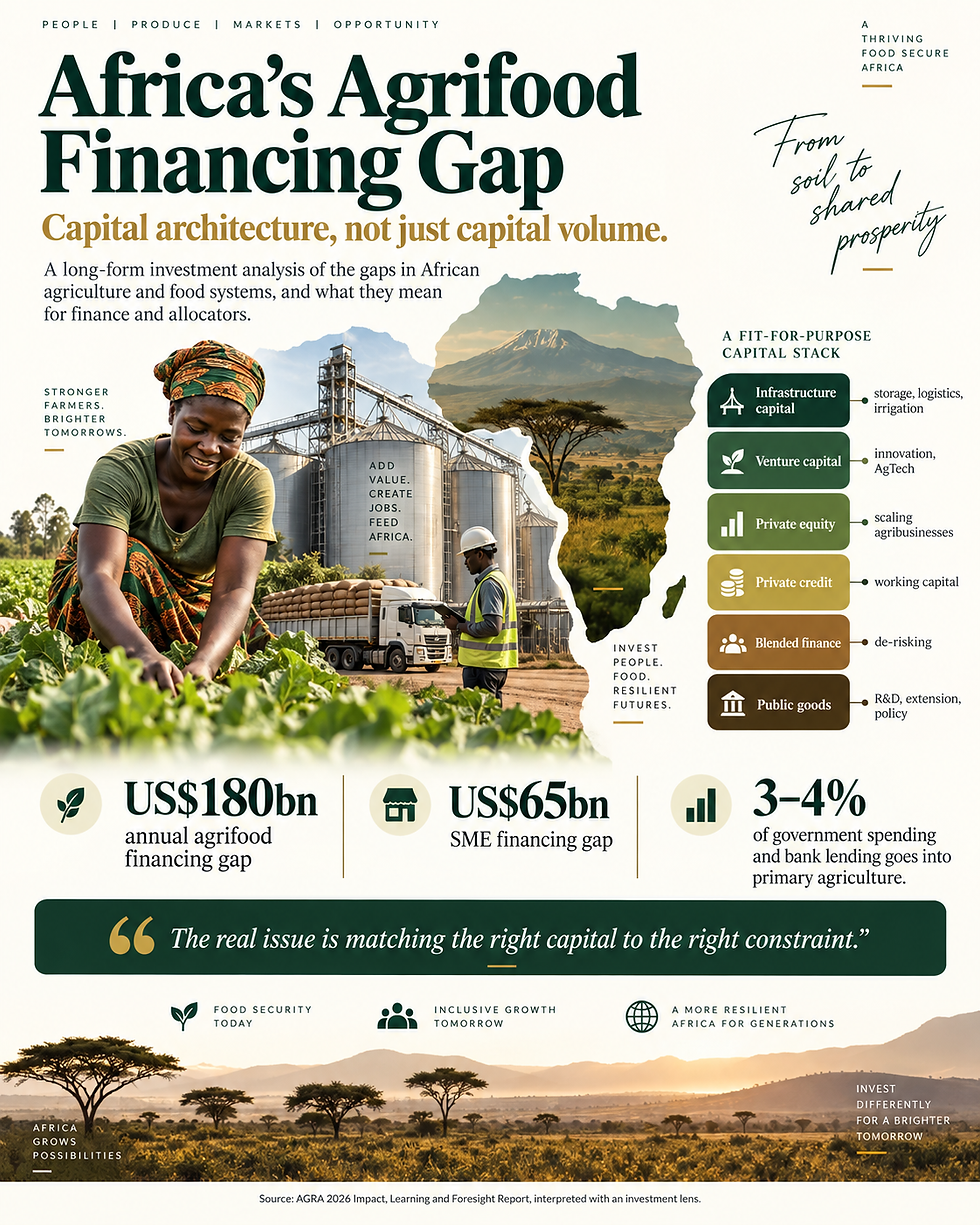
Africa does not have one agricultural financing gap. It has several different capital gaps, with different risk profiles, tenors, return expectations and owners.
That distinction matters enormously.
The headline number is US$180 billion. But the more important question is: what kind of capital is missing?
AGRA estimates an annual African agrifood financing gap of around US$180 billion, including approximately US$65 billion for small and medium-sized agribusinesses. At the same time, only around 3 to 4% of government expenditure and bank lending goes into primary agriculture, despite the sector supporting about half of African employment.
It is tempting to conclude that the answer is simply "more money".
I do not think it is.
A US$180 billion financing gap cannot sensibly be treated as a single asset class.
- An irrigation scheme requiring twenty-year infrastructure capital is not the same investment proposition as an agro-dealer needing seasonal inventory finance.
- A regional cold-chain platform is not the same risk as a pre-revenue AgTech company.
- A profitable grain aggregator requiring US$3 million of working capital should not be financed like a smallholder farmer requiring US$500 for seed and fertiliser.
- And neither should be financed like soil restoration, rural roads, agricultural research or phytosanitary systems, where much of the economic return accrues to the wider economy rather than directly to the asset owner.
- Public goods should be financed as public goods.
- Early market failures should be financed concessionally.
- Commercial businesses should receive commercial capital.
- And blended finance should be used specifically where a measurable risk or transaction-cost barrier prevents otherwise viable private investment.
Recent Aceli Africa data illustrate the point particularly well. Its 2025 benchmarking covered some 32,000 loans worth US$2 billion across 41 lending institutions in Kenya, Rwanda, Tanzania, Uganda and Zambia. Lending economics varied dramatically by ticket size. Banks generated an estimated 8.4% margin on loans between US$500,000 and US$2 million, but only 1.6% on US$25,000 to US$50,000 loans, and negative 2.2% on loans between US$10,000 and US$25,000. Aceli calculates that its incentives improve agri-SME lending profitability by around three percentage points.
That is a crucial allocator insight.
Some African agricultural credit is constrained not because borrowers are inherently unviable, but because transaction economics make the ticket unattractive.
The solution may therefore be credit guarantees, portfolio first-loss structures, origination subsidies, better data and credit scoring, digital servicing, warehouse-receipt systems or aggregation of loans into investable portfolios.
Not simply cheaper capital.
1. The "hidden middle" may be one of Africa's largest overlooked investment opportunities
Perhaps the most important investment message in the AGRA report sits between the farm and the supermarket.
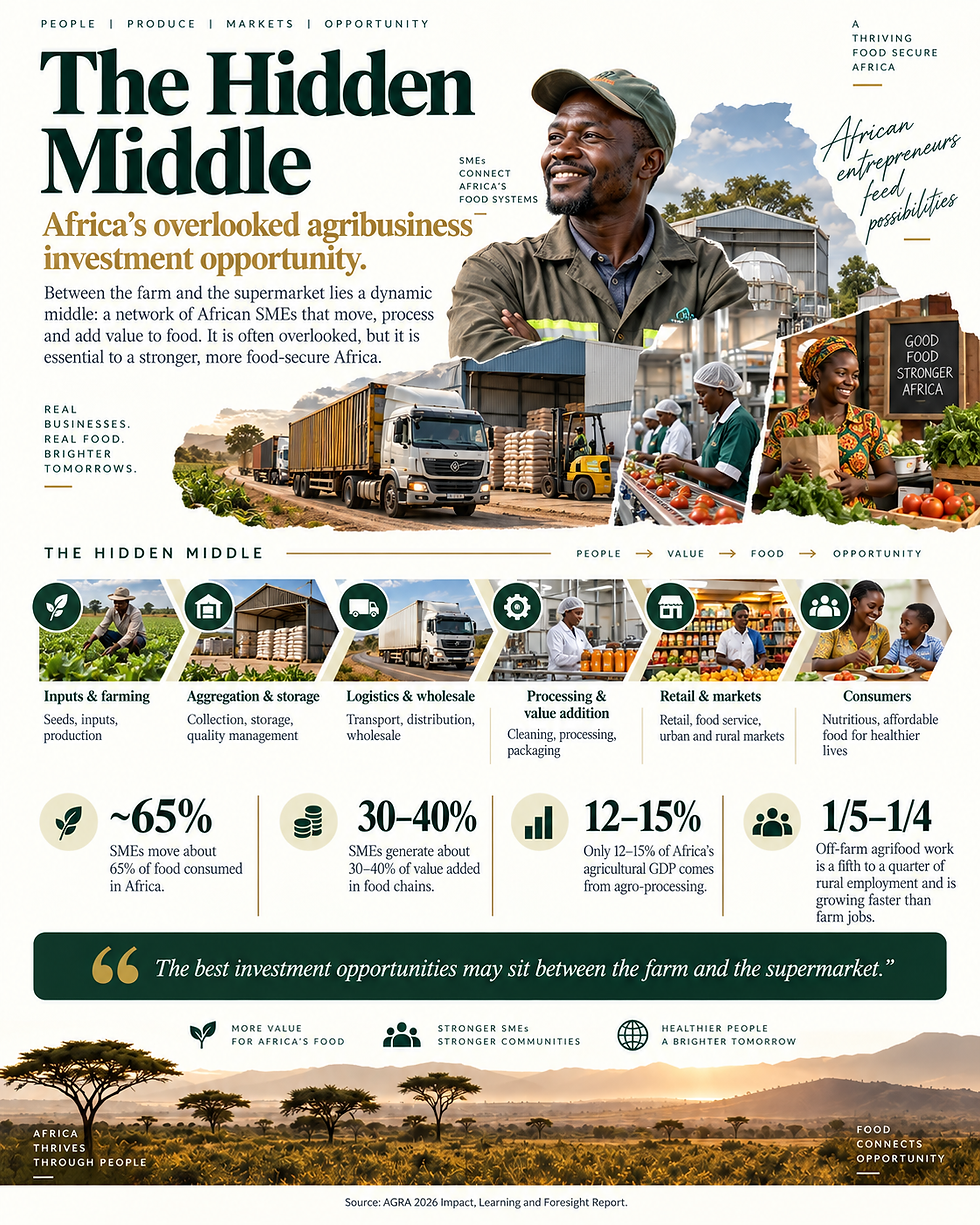
AGRA estimates that SMEs now move roughly 65% of food consumed in Africa and account for 30 to 40% of value added within food chains. Off-farm agrifood employment already represents perhaps one-fifth to one-quarter of rural employment and is growing faster than farm employment.
Yet this "hidden middle" remains poorly financed. Think about what sits there:
aggregation, warehousing, primary processing, milling, packaging, cold storage, logistics, veterinary services, feed manufacturing, hatcheries, equipment rental, wholesale markets, food distribution, testing laboratories, traceability, commodity trading, last-mile input distribution and increasingly digital market infrastructure.
These businesses are not peripheral to agricultural transformation.
They are the transmission system through which productivity becomes economic value.
AGRA also points out that only around 12 to 15% of African agricultural GDP currently comes from agro-processing, compared with more than 60% in developed regions.
That is an extraordinary structural gap. And it raises an important question for allocators. Why do we continue to frame African agricultural investment predominantly around farmers when much of the investable value may sit immediately upstream and downstream of them?
- A professionally managed warehouse serving 20,000 farmers may be more investable than financing 20,000 farms individually.
- A poultry feed mill can create demand for maize and soybean farmers while improving the economics of poultry production.
- A cold-chain business can simultaneously reduce losses, increase producer prices, improve food availability and create an entirely new market for horticulture.
- A processor with dependable demand can become the credit anchor for an entire supply chain.
This is where private equity, private credit and family-office capital have a particularly important role.
2. African agriculture needs to move from "produce and hope" to investing backwards from demand
One of the most persistent mistakes in agricultural development has been to begin with production.
- Grow more maize.
- Produce more rice.
- Increase vegetable yields.
- Distribute better seed.
AGRA's twenty-year evidence is quite clear that this is insufficient. Better seed and agronomy produce much stronger outcomes when farmers simultaneously have finance, aggregation and reliable buyers. Higher production alone did not consistently translate into higher incomes or resilience.
From an investment perspective, this suggests almost the opposite sequence:
Start with demand.
- Who buys?
- At what specification?
- At what price?
- At what volume?
- With what seasonality?
- Where is it processed?
- What logistics are required?
- What supply assurance does the processor need before investing?
Africa's 2025 food-import bill was around US$65 billion. AGRA warns that under current trends it could roughly double to US$130 billion by 2035.
That is obviously a food-security concern. But it is also an industrial investment map. Not every imported food should be produced locally. Import substitution for its own sake is poor economics.
But US$130 billion of prospective imports provides an enormous data set identifying where competitive domestic and regional value chains might be built.
- Rice.
- Edible oils.
- Wheat products.
- Dairy.
- Poultry.
- Animal feed.
- Aquaculture.
- Processed fruit and vegetables.
- Starches.
- Packaged foods.
- Ingredients.
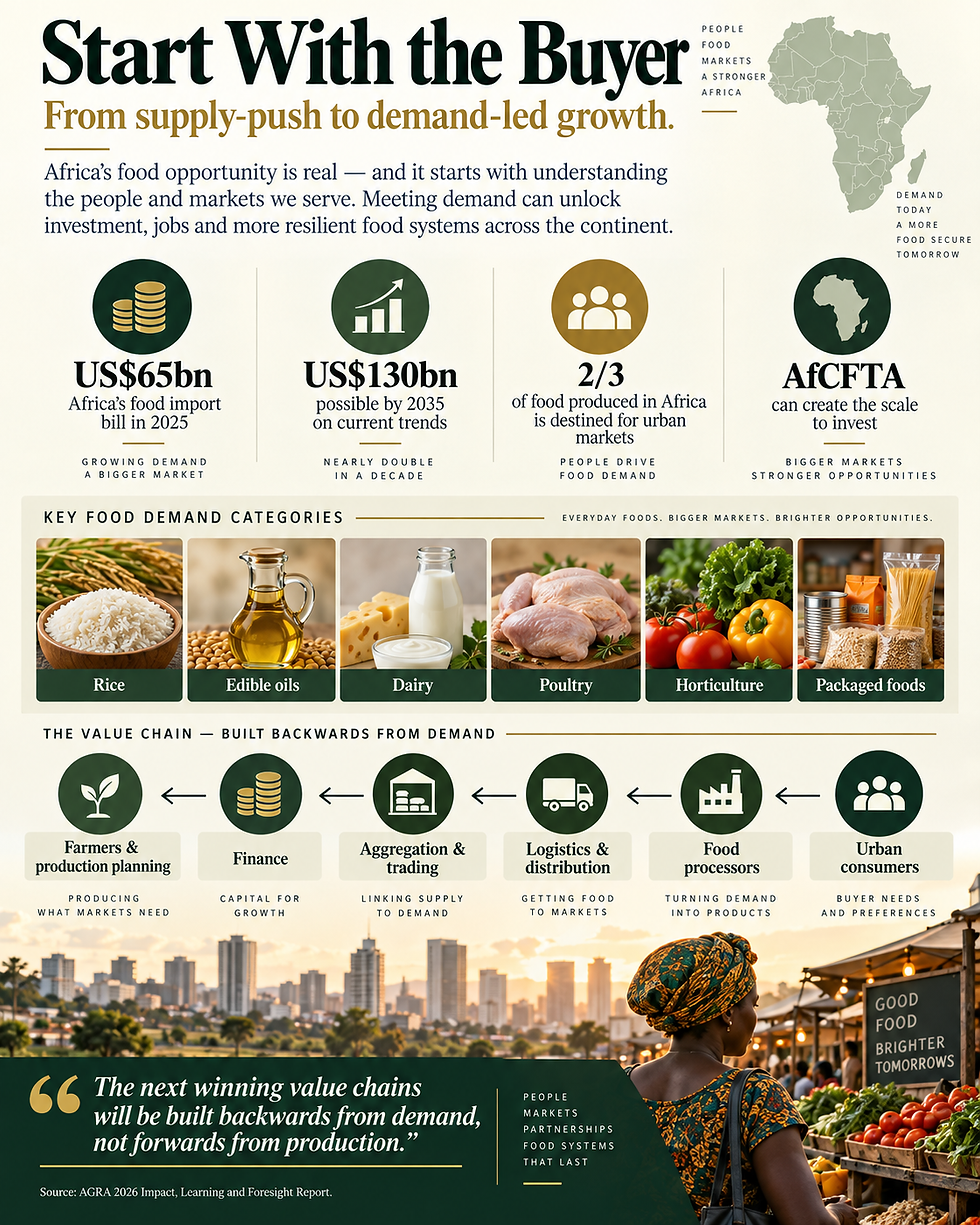
AfCFTA then changes the addressable market. The successful agribusiness of the next twenty years increasingly needs to be underwritten against regional demand rather than only national consumption.
3. Irrigation, soil and climate resilience should increasingly be treated as productive assets, not ESG expenditure
One statistic in the AGRA report should make every agricultural investor uncomfortable.
Only around 3% of cropland in sub-Saharan Africa is irrigated, compared with approximately 40% in Asia. AGRA also estimates that 65% of Africa's productive land is degraded and that climate change has already reduced agricultural productivity growth substantially.
This changes the investment equation. Climate resilience is not a nice additional impact metric sitting beside the financial model.
It increasingly belongs inside the financial model.
- Water security affects yield.
- Soil health affects fertilizer efficiency.
- Shade and biodiversity can affect crop resilience.
- Solar irrigation changes operating costs.
- Weather intelligence changes planting decisions.
- Climate-resilient genetics changes yield volatility.
- Insurance changes creditworthiness.
- Regenerative practices can reduce long-term production risk.
One can envisage investment vehicles combining commercially viable farms and agribusinesses with solar irrigation, watershed management, soil rehabilitation, bio-inputs, agroforestry, distributed renewable energy and climate insurance.
- Some returns will come through cash flows.
- Some through increased asset values.
- Some through lower volatility.
- Some potentially through verified environmental outcomes.
4. Africa's next agricultural investment unit may be the cluster, corridor or platform rather than the individual company
AGRA identifies another problem that investors have encountered for decades. Even potentially good investments fail when complementary investments do not happen simultaneously.
- A processor cannot operate economically without supply.
- Farmers will not expand supply without a buyer.
- Banks will not finance farmers without predictable cash flows.
- Logistics companies will not invest without throughput.
AGRA reports that at every stage of many African value chains, at least 60% of activity is handled by small, informal or semi-structured actors. Staple prices can be two to three times as volatile as world benchmarks, while unreliable infrastructure and fragmented markets compound the problem.
This suggests that investors should increasingly underwrite systems of mutually reinforcing investments.
AGRA itself points towards value-chain compacts, producer-owned enterprises, investment platforms, anchor investments with supplier clusters and regional corridor platforms. Its examples range from the SAGCOT corridor in Tanzania and the Uganda Coffee Lab to the Kenya Tea Development Agency, Manufacturing Africa and AfCFTA-linked food corridors.
We are beginning to see capital move in this direction.
African Development Bank Group Special Agro-Industrial Processing Zone (SAPZ) program is explicitly attempting to combine infrastructure, agricultural production, processing and private investment. By April 2025, AfDB said it had committed more than US$934 million to SAPZs and mobilized more than US$938 million in co-financing across 27 sites in 11 countries. Nigeria's first phase alone involved roughly US$510 million in financing and was expected to attract another US$1 billion of private investment.
Whether every zone ultimately succeeds will depend heavily upon execution.
But the investment logic is sound.
Create enough infrastructure, demand, supply and policy certainty in one geography, and investments that were individually marginal can become collectively bankable.
5. The biggest agricultural risk is sometimes not weather. It is coordination.
This may be the most uncomfortable conclusion in the report. African agricultural investment is normally priced for production risk, commodity risk, foreign exchange risk, political risk and climate risk. But there is another category: Execution-system Risk.
AGRA notes that results weakened where programs relied on temporary grant funding, individual champions or outside coordination. Progress endured where local institutions, commercial incentives and accountability became embedded.
This matters to investors.
Policy consistency, government implementation capability and value-chain coordination are not merely "enabling environment" issues to be discussed in an ESG appendix.
- They affect EBITDA.
- An export restriction changes prices.
- A poorly implemented seed regulation affects supply.
- A delayed VAT refund affects working capital.
- An arbitrary import duty can destroy the economics of a processor.
- A road that exists on a government plan but not on the ground changes logistics costs.
- A farmer-support program arriving six weeks after planting is of little value.
- Investors therefore need to become better at underwriting institutional capability.
There is evidence that patient agricultural capital can work
The sector is difficult, but it should not be confused with being inherently commercially unattractive.
AgDevCo's 2025 results provide an interesting data point.
- It reported US$57 million of new and follow-on investments during the year, an executed portfolio of US$266 million and US$368 million under management across 38 companies in 12 sub-Saharan African countries.
- Portfolio companies generated approximately US$581 million of revenue and US$76 million of EBITDA while supporting more than 38,000 jobs and engaging more than 2.6 million small-scale farmers, traders and customers.
What this means for capital allocators
The AGRA report identifies five requirements that need to move together: profitable and resilient production, better connections between supply and demand, value-adding markets, investment capable of managing agricultural risk, and institutions capable of sustained delivery.
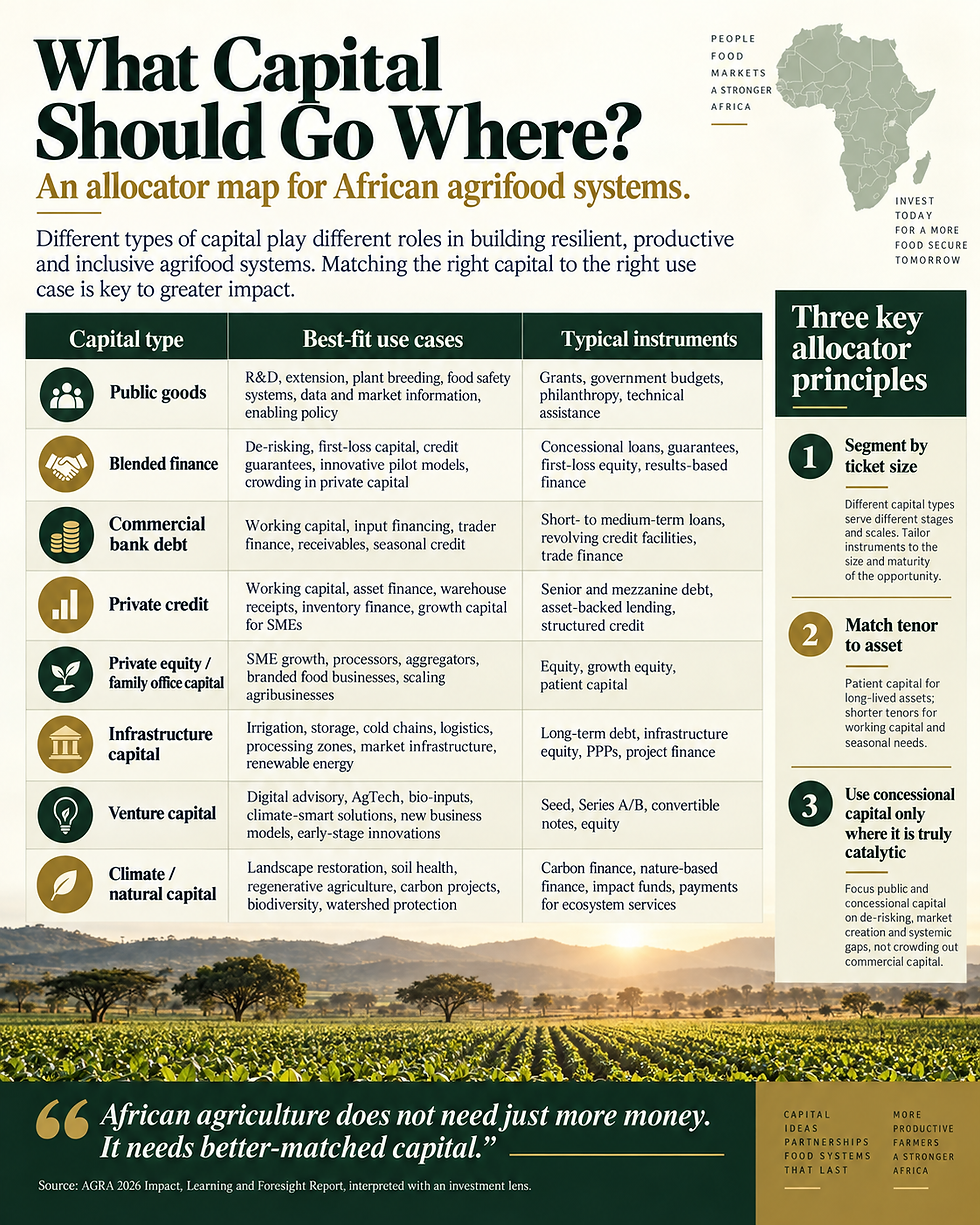
My investment interpretation is that each category of capital now needs to become considerably more deliberate about where it sits.
1. DFIs should concentrate scarce concessional capital on additionality: first loss, guarantees, project preparation, market infrastructure, long-tenor investments, local-currency risk and investments that crowd in commercial capital. 2. Commercial banks should increasingly finance established agricultural cash flows, particularly working capital, inventory, equipment and larger SMEs, with portfolio risk-sharing where justified. 3. Private equity and family offices have an important opportunity in the US$1 million to US$20 million space where good businesses are often too large for microfinance and too small, unfamiliar or operationally complex for mainstream institutional investors. 4. Infrastructure investors should look harder at irrigation, cold chain, storage, logistics, wholesale markets, renewable energy and processing infrastructure. 5. Natural-capital and climate investors need models where landscape restoration, water, soil, biodiversity and carbon outcomes improve agricultural economics rather than sit apart from them. The rise of platforms like our own partnership with FellowFuture - Regenera Natural Capital, as well as Verdant Impact Partners, Inc are helping to support this agenda, weaving in things such as landscape management systems and agri-tourism, for example Agriourism Africa of the solution. 6. Venture investors should be cautious about believing that another app will solve structural agricultural problems. The strongest technologies will be those that reduce a genuine cost, improve yields, make risk measurable, lower transaction costs, improve market access or enable finance. AGRA notes that more than US$1.8 billion of venture capital has entered African agrifoodtech since 2013, an ecosystem that barely existed two decades ago. 7. And governments and philanthropy must continue financing things that the private sector cannot efficiently capture: research, regulatory systems, extension architecture, farmer registries, standards, public infrastructure and institutional capacity.
The next African agricultural opportunity is not simply on the farm.
AGRA's report estimates that successful agrifood transformation could ultimately generate more than US$1 trillion of additional GDP by 2045. Africa could have around 2.5 billion people by 2050, including roughly 1.5 billion urban consumers.
That is a market-development thesis of considerable scale. But those returns will not be captured by simply financing more hectares. They will be captured in the infrastructure connecting those hectares to consumers:
- water,
- genetics,
- inputs,
- finance,
- aggregation,
- storage,
- energy,
- processing,
- logistics,
- data,
- insurance,
- wholesale markets,
- regional trade,
- brands,
- and increasingly natural-capital management.
It lacks sufficient numbers of complete investment ecosystems in which good farmers, good businesses, good infrastructure, capable institutions and appropriate capital reinforce one another.
That is the challenge.
But for investors prepared to look beyond the individual transaction, it may also be the opportunity. The real question for the next decade is therefore not:
> "How do we put more money into African agriculture?"
It is:
> "How do we allocate the right capital, to the right part of the food system, at the right time, so that the whole system becomes more productive and more investable?"
That is a substantially more difficult question.
It is also a much more interesting investment proposition.
by Lloyd D. Le Page, Group Chairman, Sarnian Group, Inc
References: AGRA's 20 year analysis and foresight report; African Food Systems Forum; uBeba; Rift Valley Traders and Associates, Inc; Aceli Africa; African Development Bank Group; SAGCOT corridor; AgDevCo; FellowFuture; Regenera Natural Capital; Verdant Impact Partners, Inc
This piece was written for and first published by AgriNexus, the Group's agricultural investment intelligence venture. The original is canonical.